
BestHairClinic: What are the Differences Between FUE and DHI?
The most asked question by those considering a hair transplant: FUE or DHI? We explain all the differences between the two techniques from graft extraction to the implantation process, healing, and unshaven options.

Hair transplant specialist Alp Eren Akinturk Tuna is a pioneer in hair restoration. Having completed his subspecialty in the USA, he is the developer of innovative methods such as stem cell-supported FUE and Bio-Harmonic hairline. The internationally award-winning Tuna shares his knowledge with his patients at NK Aesthetics, which he founded. (This biography was created for trial purposes.)
What are the Differences Between FUE and DHI Techniques? Which Method is Suitable for Whom?
Hair transplant technology has made great progress in recent years, and at the forefront of this progress are two modern techniques: FUE (Follicular Unit Extraction) and DHI (Direct Hair Implantation). These two abbreviations, which almost everyone considering a hair transplant encounters, are frequently confused with each other, or there is confusion about which is "better."
As a physician, I would like to state this right from the start: There is no single technique that is absolutely "superior" to the other. Both methods have their own unique advantages, and the most correct method should be determined specifically for the person by the doctor, in line with the patient's hair structure, degree of shedding, donor area capacity, and expectations.
In this article, to make your decision-making process easier, we will examine in detail what these two popular techniques are, how they are applied, the main differences between them, and for which situations they are more suitable.
What is the FUE (Follicular Unit Extraction) Technique?
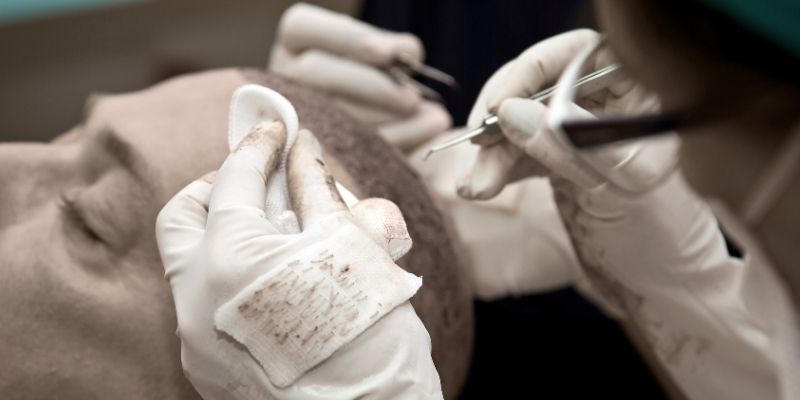
FUE is a revolutionary method that forms the basis of modern hair transplantation. As the name suggests, in this technique, hair follicles (grafts) are extracted one by one from the donor area (usually the nape) with the help of a special micromotor.
The application process of the FUE technique basically consists of two main stages:
-
Extraction of Grafts: With the 0.6 to 1.0 mm diameter cylindrical needles (punches) at the tip of the micromotor, each hair root unit is loosened with a circular incision along with its surrounding microscopic tissue and collected with tweezer-like forceps. These collected grafts are kept in a special solution to be ready for implantation.
-
Opening Channels and Implantation: This stage is the most distinguishing feature that separates FUE from DHI. The doctor opens the "nests," i.e., channels, where the grafts will be placed into the area to be transplanted with special metal blades (slits) or with sapphire tips as in the more modern approach, the Sapphire FUE technique. After all channels are opened, the collected grafts are placed one by one into these channels with the help of forceps.
What is the DHI (Direct Hair Implantation) Technique?
DHI can actually be considered a subtype or a different application form of the FUE technique. The way grafts are collected is almost identical to FUE (micromotor is used again). What makes DHI completely different is the way these collected grafts are implanted.
The distinguishing feature of the DHI technique is the use of a special medical tool called "Choi Implanter Pen":
-
Loading Grafts into the Pen: The collected grafts are individually loaded by nurses into the hollow needle at the tip of the Choi pen.
-
Direct Implantation: Using this graft-loaded pen, the doctor inserts it into the transplant area and presses the piston mechanism at the back of the pen, leaving the graft directly under the skin. In this process, channel opening and implantation occur simultaneously. That is, unlike FUE, there is no prior channel opening process in the DHI technique.
Main Differences Between FUE and DHI
| Feature | FUE (Follicular Unit Extraction) | DHI (Direct Hair Implantation) |
| Implantation Method | First channels are opened, then grafts are placed with forceps. (Two-stage) | Channel opening and implantation are done simultaneously with a Choi pen. (Single-stage) |
| Shaving Requirement | Generally, the area to be transplanted needs to be completely shaved. | Implantation can be done among existing hair without shaving the area to be transplanted (unshaven hair transplant). |
| Maximum Grafts | More efficient for reaching high graft numbers (4000-5000+) in a single session. | Since it is a more meticulous and time-consuming process, slightly lower graft numbers (2500-3500) are usually targeted in a single session. |
| Recovery Process | Bleeding and scabbing may be slightly more due to the channel opening process. | It is observed that bleeding and scabbing are generally less due to point-by-point implantation. |
| Density | Very effective for covering large and completely empty areas. | Ideal for densifying existing hair and achieving a denser look. Provides more control over hair direction and angle. |
Which Method is More Suitable for You?
-
You Can Consider the FUE Technique If:
-
You have a large balding area and need a high number of grafts.
-
Having your hair completely cut is not an issue for you.
-
Your budget is more limited (DHI is generally slightly more expensive due to the special pens used).
-
-
You Can Consider the DHI Technique If:
-
You do not want your hair cut (if unshaven hair transplant is important to you).
-
Densification is to be done by going in among your existing hair.
-
You demand a dense transplant in smaller areas (hairline, crown area, etc.).
-
DHI is generally the first choice for female patients or male patients who want to keep their hair long.
-
In conclusion, both FUE and DHI are highly effective techniques that give excellent results when applied in the right hands. The right decision for you will be determined by a detailed consultation with an experienced physician who will evaluate your hair loss type, the condition of your donor area, and your aesthetic goals.
Most Read
Is Unshaven Hair Transplant Possible? All Details
Alp Eren Akinturk
How is Hair Transplant Done in Women? What are the Differences?
Alp Eren Akinturk
Things to Do Before a Hair Transplant
Alp Eren Akinturk
How to Choose the Right Shampoo for Your Hair Type?
Alp Eren Akinturk
What is FUE Hair Transplant? How is it Done?
Alp Eren Akinturk